
Ground Reaction Forces in the Golf Swing: What Force Plates Can Tell You
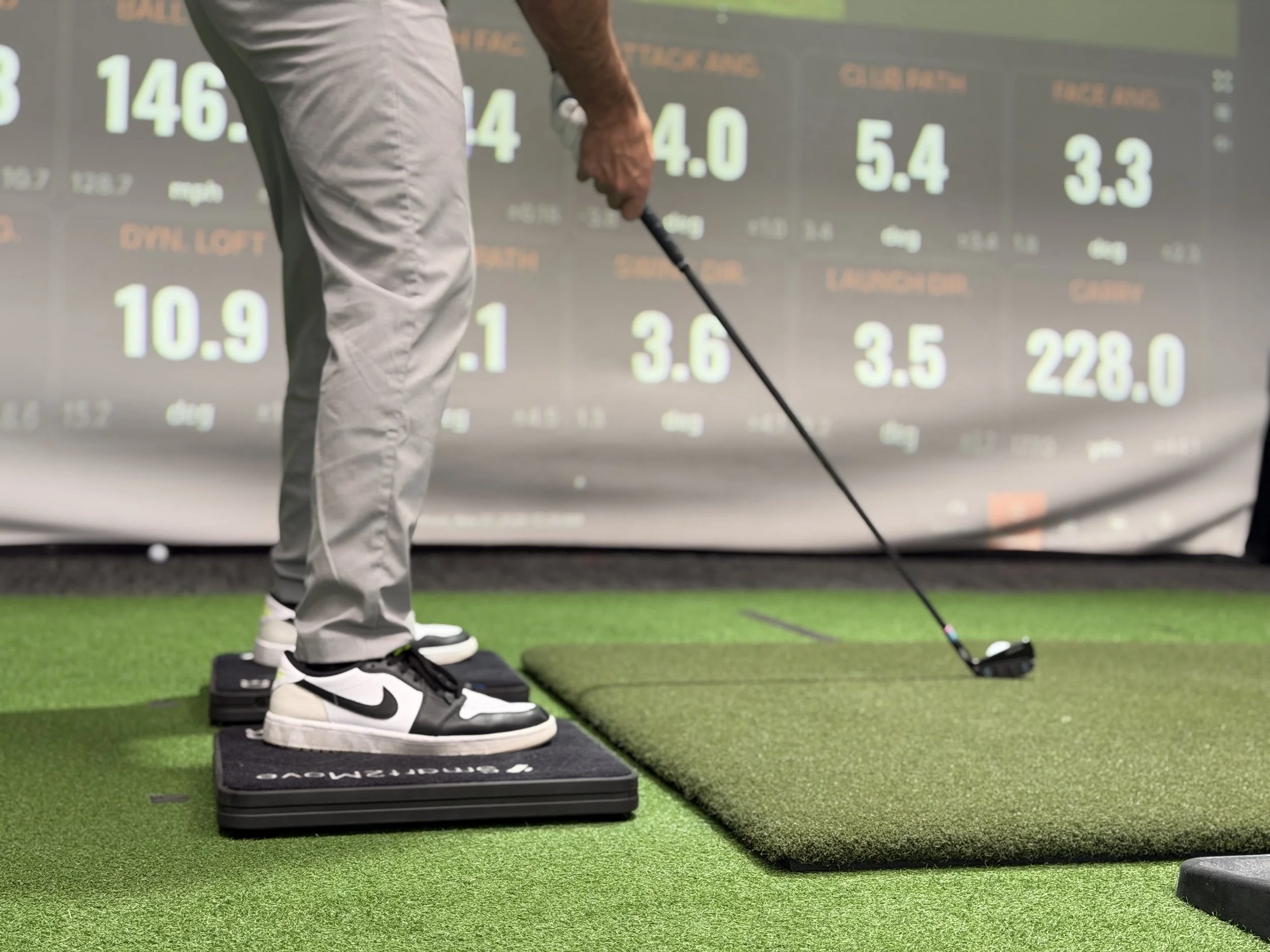
You hit two drives that look nearly identical on video. One comes off the center of the face and flies 15 yards farther. What changed?
TrackMan can show you what happened at impact. Swing video can show you how you moved. Force plates add another piece of the picture by showing how each foot interacted with the ground during the swing. Put those together, and you can start to understand what you did differently on the swing you’d like to repeat.
What are ground reaction forces?
When you push against the ground, the ground pushes back with an equal and opposite force. That’s a ground reaction force. You feel it when you jump, change direction, or push off on skates. In a golf swing, those forces change from takeaway through impact as you load, shift, and turn.
A pair of 3D force plates measures the force under each foot in three directions.
Force Direction: What it measures in the golf swing
Vertical
How hard the ground pushes upward under each foot.
Side to side
How much lateral force acts toward or away from the target.
Toe to heel
How much horizontal force acts toward or away from the ball.
You might hear a coach say, “Get more pressure into your lead foot.” In practice, there are two questions worth asking. When does the lead foot start taking on more load, and how much force is actually there? Your lead foot can account for a larger share of the total vertical force even while the force under both feet is dropping. Looking at both traces helps explain what’s happening behind that percentage.
Force plates can also track your center of pressure, the location where the combined vertical force under your feet acts. It can move toward the target while your hips and chest move very little. That’s one reason a golfer can feel a shift into the lead foot with very little visible slide on video.
Does using the ground help you swing faster?
Research has found links between how golfers use the ground and how fast they swing. In a study of 63 highly skilled male golfers, several force and torque measurements were associated with clubhead speed. A broader review of 24 studies also found associations between clubhead speed and measures of ground reaction force or center of pressure.
For an individual golfer, the practical question is what changes when you swing faster and still hit the middle of the face? Peak force is one piece of that comparison. The timing matters too. If you’re looking at how the lead leg contributes before impact, for example, a peak that occurs after the ball is gone tells you less than what the force trace was doing during the downswing.
What a force plate assessment looks like
At Denver Golf Performance, we use Smart2Move dual force plates alongside TrackMan and swing video. We start with a series of your normal swings, then compare better shots with your typical misses. That gives us a baseline for testing a change.
Say your best drives show your lead foot taking on load a little earlier than it does on your common miss. We can try a cue that helps you feel that shift sooner, then hit another set of balls. The plates tell us whether the cue changed the timing. TrackMan and strike location help us judge whether the change improved the shot. If contact gets worse or the ball starts missing farther offline, that’s useful feedback too.
That’s where the assessment can save you practice time. You leave with a specific feel or drill, a reason for working on it, and a ball-flight or strike cue you can check on the range. For one golfer, that might mean finding a little more speed with the driver. For another, it might mean making iron contact more predictable.
Book a Smart2Move Force Plate Assessment in Denver
Bring the club you want to understand better, whether that’s the driver you’re trying to swing faster or the iron you struggle to strike consistently. We’ll measure your swing, test a change, and give you a clear focus for your next practice session.
Denver Golf Performance · 90-minute standalone assessment · $425